


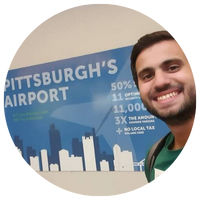
1. Personal information
a. Birth: Mr. Abdelrahman was born in late 1995. He was arrested as a child, before turning 18.
b. Upbringing: He grew up in Cairo Governorate and excelled at school. He won a scholarship to study engineering at the German University in Cairo (GUC), but lost it the moment he was arrested in 2013. Even so, he insisted on continuing his education and earned a bachelor’s degree in engineering from Ain Shams University while in prison.
c. Occupation: Writer. His writing from inside prison was published by Mada Masr, and after his release he continued writing for many media outlets, most notably Raseef22 and the Tahrir Institute for Middle East Policy.
d. Political activity/affiliation: He did not belong to any political party or group.
e. In the spotlight: The child Abdelrahman came into the spotlight through the writing he became known for inside prison. He kept writing articles, published regularly, about his prison conditions, his fellow prisoners and his own thoughts, which led many human rights defenders and organizations to call for his release.
2. Previous arrests: Mr. Abdelrahman was not arrested in any other case.
3. Timeline from arrest to the end of detention
a. Background of the arrest:
– 6 October 2013, arrest: The child Abdelrahman El-Gendy was with his father in their car in Ramses Square, on the way to visit his grandmother. When he saw what was happening he took out his phone to take some photos, and two men in civilian clothes arrested both of them without giving any clear reason.
– 7 October 2013, appearance before the prosecution: The child Abdelrahman appeared before the prosecution about 25 hours after his arrest, facing several charges, the best known being joining a banned group. His father was added to the same case.
b. Background of the case: He was added to Case No. 10325 of 2013 Azbakeya Felonies, known in the media as the “Azbakeya riots” case.
The case began in 2013, at the same time as the 6 October anniversary celebrations, when a number of protesters gathered in Ramses Square to reject the military coup in Egypt and to denounce the dispersal of the Rabaa Al-Adawiya sit-in. The case included 68 defendants, among them men and children, who faced several charges including premeditated murder, damaging public property and resisting the authorities. The court handed down sentences ranging from 3 years in prison to 15 years of aggravated imprisonment.
c. Charges: Mr. Abdelrahman faced many charges, as follows:
– Premeditated murder.
– Attempted premeditated murder.
– Assembly with the aim of obstructing the enforcement of laws and regulations.
– Assaulting citizens.
– Damaging public property.
– Resisting the authorities.
– Attempting to storm Tahrir Square.
d. Trial and sentences:
– March 2014, referral to the Criminal Court: The case was referred to the Cairo Criminal Court, presided over by Counselor Mohamed Ali El-Feki, which held its first hearing on 17 April 2014 at the Police Institute in Tora.
– 30 September 2014, Criminal Court verdict: The court sentenced him to 15 years of aggravated imprisonment, 5 years of police surveillance and a fine of EGP 20,000. The court treated the child Abdelrahman as an adult and ignored the fact that he was a minor (17 years old) when arrested. The Cairo Criminal Court sentenced him to aggravated imprisonment in violation of Child Law No. 12 of 1996, as amended by Law No. 126 of 2008, whose Article 111 states: “The death penalty, life imprisonment or aggravated imprisonment shall not be imposed on a defendant who had not reached a full eighteen calendar years of age at the time of committing the crime.”
– March 2016, first Court of Cassation ruling: The Court of Cassation rejected the appeal filed by Mr. Abdelrahman El-Gendy and upheld his sentence, but it cancelled the fine for all defendants.
– 31 March 2017, inclusion on the pardon lists: Mr. Abdelrahman and his father were included on the official list of convicted prisoners awaiting a presidential pardon. His father was released, but Mr. Abdelrahman stayed in prison and was not lucky enough to escape the ordeal.
– November 2019, petition for reconsideration: Lawyers from the Belady organization filed a petition for reconsideration of the case, on the grounds that at the time of the incident he was a child who had been sentenced to 15 years of aggravated imprisonment in violation of the Child Law.
– December 2019, suspension of the sentence: His father, together with a human rights lawyer, filed a motion with the Public Prosecutor to suspend the sentence issued against him as an adult while he had been a child. The motion was accepted and the Public Prosecutor ordered the sentence suspended.
– 30 December 2019, release: The South Cairo Criminal Court ordered the release of Mr. Abdelrahman with his place of residence as guarantee. On 12 January 2020 he was actually released, to await the trial session at home, outside the prison walls.
– 14 September 2020, final verdict, second Court of Cassation ruling: The Court of Cassation, at the North Cairo Criminal Court, reduced Mr. Abdelrahman’s sentence to five years in prison after he was retried as a minor. He had already served the full term, so he did not return to prison after his release.
4. Detention conditions
a. Places of detention: Mr. Abdelrahman moved between seven places of detention, some together with his father and others alone. They spent their first night in Azbakeya Police Station, then were moved to the El-Salam Central Security camp, where they stayed for ten days. They spent the first year in El-Marg General Prison and were then moved together to Wadi El-Natrun Prison, where Mr. Abdelrahman was separated from his father. His father was transferred to Tora Maximum Security Prison 2 in preparation for his inclusion in the pardon program and was released in March 2017, while his son Abdelrahman spent about two years in Wadi El-Natrun, and finally three years in Tora Maximum Security Prison 2. During exam periods he was also held in Tora Reception Prison and Tora Liman.
b. Violations:
– Being detained with adults while a minor.
– Beating and degrading treatment by police officers right after his arrest.
– Beating and degrading treatment during the “reception parties” (tashrifa) in each prison he entered for the first time. The Wadi El-Natrun reception was the most brutal.
– Restrictions on bringing in study materials, or their deliberate destruction by National Security, with access to them possible only by paying large bribes.
– Regular theft of belongings by inspectors and informants during searches.
– Forced head shaving inside Wadi El-Natrun Prison.
c. Living conditions in prison:
He was imprisoned for nearly six years and moved between about six prisons. His journey took him from childhood to adolescence and then to young adulthood. Throughout this long period he suffered poor detention conditions, from overcrowding that made it impossible to sleep lying down with a rested body, to difficult access to toilets, studying by flashlight in a space of no more than 30 cm, and short visits.
As a result of his arrest and inclusion in a political case, he lost the scholarship to study engineering at the German University in Cairo that he had earned through his excellent results in secondary school.
Mr. Abdelrahman described missing some basic things as follows:
“A pillow instead of the slipper I rest my head on. Something soft to sleep on instead of the floor. Stretching my legs while I sleep. Turning over. Sleeping with peace of mind that I won’t wake up to someone cursing or a hand slapping the back of my neck. Using the toilet without waiting for 25 people ahead of me. A place to study and something higher than the floor to lean on. Seeing my family for more than half an hour every two weeks. Drinking clean water. Seeing the sun. Sitting my exams. Taking a breath without remembering that I’m a prisoner.”
5. Follow-up:
a. Work and activity: He recently won a scholarship for a Master’s in Creative Writing at the University of Pittsburgh in the United States.
b. Place of residence: He recently moved to Pennsylvania, United States, to continue his studies there.
c. Personal life: He resumed his life after leaving prison and set out to learn as much as he could with every means available. He earned certificates in teaching English and took creative writing courses in both Arabic and English, until he won a scholarship at the University of Pittsburgh for a Master’s in Creative Writing.