


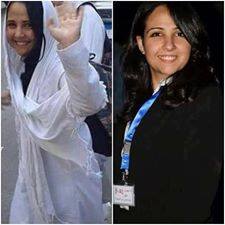
1. Personal information:
a. Birth: Ms. Aya was born on 23 January 1987 in Saudi Arabia. She was arrested at the age of 27.
b. Upbringing: She grew up and studied between the United States, Saudi Arabia and Egypt. She obtained US citizenship as a young child through her father, who worked there before she was born. She graduated from the Faculty of Law at Cairo University and also earned a bachelor’s degree in Conflict Analysis and Resolution from George Mason University in Virginia, United States. At the time she was working in the field of human rights.
c. Occupation: Director of the Belady: An Island for Humanity Foundation.
d. Political activity/affiliation: Political and social activist and human rights defender.
e. In the spotlight: Ms. Aya came into the spotlight after appearing on the program “Zay El-Shams”, after she founded the “Belady” initiative to clean Egyptian streets following the 25 January 2011 revolution. She became widely known in 2014 when she and her husband, Mr. Mohamed Hassanein, founded the Belady: An Island for Humanity Foundation, whose most important project was a program to rehabilitate street children. She then appeared on several TV programs such as “Set El-Hosn”, and on Egyptian radio with presenter Ahmed Younis. Later, however, security forces arrested her together with her husband and some of the foundation’s volunteers. The Public Prosecution claimed that a complaint from a father accusing the foundation of holding his son was the reason for their arrest. She became even more widely known through the local and international advocacy campaigns that led the US government to call for her release. She was finally released in 2017 and met US President Donald Trump, which was followed by a campaign in the Egyptian regime’s media accusing her of espionage.
2. Previous arrests: She was not arrested in any other case.
3. Timeline from arrest to the end of detention:
a. Background of the arrest
– 1 May 2014, arrest: Ms. Aya was arrested together with her husband and some members of the Belady team, following a complaint filed by the father of one of the children. This came after an assault on the foundation’s members, which led them to call the police for help; the police came and arrested them.
– 3 May 2014, appearance before the prosecution: She was brought before the prosecution 48 hours later and faced several charges, the best known being human trafficking.
b. Background of the case: Case No. 4252 of 2014 Abdeen Felonies, known in the media as the “Belady Foundation case”.
– The case goes back to 2014, when the family of one of the children raided the foundation and attacked the Belady team and the children inside with clubs, smashing equipment.
– Mr. Mohamed Hassanein went to the competent police station to file a complaint against the relatives involved in the incident, while Ms. Aya was calling the police for help by phone. A police officer was sent to the foundation; his response was “What’s it to me?”, he asked for money for having come, and then left. Soon after, Mr. Mohamed Hassanein was brought back under arrest in a police station microbus, and his wife and a number of Belady team members were arrested, along with all the children.
c. Charges:
– Founding, organizing and managing a criminal group for the purposes of human trafficking, by dealing in natural persons, namely the child victims, through sheltering and receiving them, using force, violence and threats, abduction, fraud and deception, exploiting their weakness and need, with the intent of sexually exploiting them in pornographic material, and using them in protests and fundraising.
– Indecent assault of the child victims using force and threats, by forcing them to undress, exposing their private parts and photographing them, and forcing them into debauchery and sex.
– Abducting male children through deception and coercion, by exploiting their poverty, need and weakness and misleading them with promises of shelter, food and clothing, luring them to a place out of sight and holding them by force in an apartment prepared for that purpose.
– Detaining children without an order from a competent authority and outside the cases permitted by law, by luring them to an apartment prepared for that purpose, physically torturing some of them, and beating them to prevent them from escaping and to force them into debauchery and sex.
– Establishing an entity called the “Belady Association” that carries out the activities of associations without following the legally prescribed rules.
d. Trial and sentences:
– September 2014, referral to the Criminal Court: The competent prosecution referred Ms. Aya Hijazi, her husband and the other members of the foundation to the Cairo Criminal Court to begin their trial.
– January 2015, first hearing scheduled: The first hearing of the case was scheduled before the Cairo Criminal Court sitting in Abdeen, to be held in March 2015.
– March 2015, first trial hearing: At its first hearing, the Cairo Criminal Court sitting in Abdeen, presided over by Judge Mohamed Ali El-Feki, adjourned the case to a session in May 2015, followed by several more adjournments.
– 16 April 2017, acquittal: The Cairo Criminal Court, presided over by Judge Mohamed Ali El-Feki, acquitted Ms. Aya, her husband and the other members of the center of all charges against them. The verdict came after US President Donald Trump received his Egyptian counterpart Abdel Fattah El-Sisi at the White House.
4. Detention conditions
a. Places of detention: Ms. Aya passed through several places of detention, starting with Azbakeya Police Station, then Abdeen and El-Darb El-Ahmar police stations, until she served her detention in Al-Qanater Women’s Prison.
b. Violations:
– At Azbakeya Police Station, right after her arrest, she was beaten and threatened with electric shocks.
– She was insulted and threatened with sexual abuse.
– She was threatened with the death penalty.
– She was banned from contact with the other political prisoners and held with criminal prisoners.
– Harassment and obstruction regarding books, letters, exercise and, at times, a radio, and frequent monitoring of her visits, especially with lawyers.
c. Living conditions in prison: Because she was widely known as a human rights defender in Egypt, she suffered harsh treatment, such as obstruction in getting books, restrictions on exercise at times, and confiscation of the rope she exercised with. The harshest restriction on communication was the ban on speaking or communicating with the other political and Islamist prisoners, along with restrictions on her contact with criminal prisoners. Some prison administrations also restricted her outgoing letters, at times requiring that they not exceed one page, and obstructed incoming letters, keeping them for weeks and sometimes months. She was not allowed to bring in colors or knitting materials like her fellow prisoners, and she was denied a floor bed even though her turn had come more than once.
On the other hand, at times she received some preferential treatment because she held US citizenship, or because she had the sympathy of the head of investigations at the time. She was allowed to go to the prison hospital whenever she asked, which should be a basic right for all prisoners, or she was moved to a “good” ward, such as the public funds ward, instead of the investigation ward, or allowed to exercise in open spaces.
5. Follow-up
a. Work and activity: Ms. Aya runs the Belady: An Island for Humanity Foundation, whose main goal now is working for the release of children and women imprisoned in political and freedom of expression cases and providing them with psychological support. On 3 July 2022 the foundation launched a major project documenting everything related to prisons and prisoners in Egypt, the “Egypt Prison Atlas”, and it is now working to expand Belady.
b. Place of residence: United States.
c. Personal life: Ms. Aya continued her human rights work and gave birth to her daughter, Yusr. She recently earned an MBA from Harvard University.
d. Awards: She and her husband received the Project on Middle East Democracy (POMED) award for 2017.