


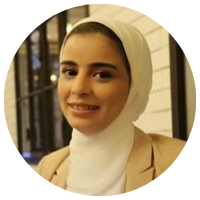
1. Personal information
a. Birth: Ms. Engy was born on 3 March 1988. She was arrested at the age of 31.
b. Upbringing: She grew up in Cairo Governorate and graduated from the Faculty of Arts, Department of Arabic Language and Israeli Studies. She worked as a teacher for about five years until the revolution inspired her to go into journalism.
c. Occupation: Journalist. She worked for several news websites and then for the Al-Shorouk and Al-Masry Al-Youm newspapers, and her articles were published on several platforms, most notably Sky News and Ida2at. She described her love for her job like this: “I felt it was my way to be close to people’s pain and hopes.”
d. Political activity/affiliation: She did not belong to any political party or group.
e. In the spotlight: She came into the spotlight when she was arrested in the wave of arrests that swept the country in September 2019, when the contractor Mohamed Ali called on Egyptians to protest against the rule of President Abdel Fattah El-Sisi. Writing about her intensified because she was a journalist doing her official job covering the events, and the head of the Journalists Syndicate, Mr. Diaa Rashwan, asked the authorities to release her.
2. Previous arrests
Ms. Engy was not arrested in any other case.
3. Timeline from arrest to the end of detention
a. Background of the arrest
– 20 September 2019, arrest: Ms. Engy was carrying her press permit from Al-Masry Al-Youm, which allowed her to cover the events legally. Even so, security forces arrested her in Abdel Moneim Riad Square and then forcibly disappeared her inside Central Security camps.
– 28 September 2019, appearance before the Supreme State Security Prosecution: Ms. Engy appeared eight days later before the Supreme State Security Prosecution, facing charges of which the best known was joining a terrorist group.
b. Background of the case
She was added to Case No. 1338 of 2019 Supreme State Security Inquiry, known in the media as the “September crackdown” case.
The case began on the evening of 20 September 2019, after the contractor Mohamed Ali and other figures called on the Egyptian people, through videos posted on social media, to protest against President El-Sisi’s rule. Egypt saw wide political mobilization, both on the street and on social media, and protests broke out in several governorates, including Cairo, Suez and Alexandria, demanding the departure of President Abdel Fattah El-Sisi. The Egyptian authorities launched a wide and random arrest campaign starting on 20 September 2019 that lasted nearly a full month. More than 3,000 people were added to this case, among them children, young people, women, girls and elderly people. Most of them were forcibly disappeared for a period before being brought before the prosecution.
c. Charges: The Supreme State Security Prosecution brought several charges against Ms. Engy, as follows:
– Taking part with a terrorist group in achieving its aims.
– Broadcasting, airing and publishing false news.
– Misuse of social media.
– Taking part in an unlicensed protest.
d. Trial/release:
– 28 September 2019, pretrial detention: The Supreme State Security Prosecution ordered her detention for 15 days pending investigations in the case mentioned above.
– 10 October 2019, release: The Supreme State Security Prosecution ordered her release pending investigations, with her place of residence as guarantee. This came after online campaigns by political activists and journalists calling on the authorities to release her, and the decision was carried out in response to them.
4. Detention conditions
a. Places of detention: Ms. Engy went through a period of unlawful detention inside Central Security camps until she was moved to Al-Qanater Women’s Prison.
b. Violations: She was subjected to a number of violations, most notably:
– Enforced disappearance for 8 days inside Central Security camps.
– Being interrogated only 8 days after her arrest.
– Being banned from visits.
– Being banned from buying from the prison canteen.
– Being given small amounts of food (prison food).
c. Conditions inside the prison
After an unlawful detention that lasted 8 days, Ms. Engy was moved to Al-Qanater Women’s Prison, where she was banned from visits and from buying from the prison canteen. This left her and her fellow prisoners dependent on prison food, which is known to be poor, and which the prison administration served in small quantities at the time because of the large number of women detained over the 20 September protests.
5. Follow-up
a. Work and activity: Ms. Engy continues her work as a journalist at Al-Masry Al-Youm and dreams of one day becoming a leading media figure. In her words: “I have always dreamed, and still dream, of being a leading media figure who speaks for people with no bias except for their rights, and that’s it.”
b. Place of residence: Cairo, Egypt.