


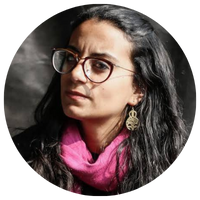
Personal information
a. Birth: Ms. Mahienour was born on 7 January 1986 in Alexandria Governorate. She has been arrested several times, at the ages of 22, 27, 28, 31 and 33.
b. Upbringing: Ms. Mahienour grew up in Alexandria. Although an accident in her childhood cost her the sight in her right eye, it did not hold her back, and she graduated from the Faculty of Law at Alexandria University.
c. Occupation: Lawyer and human rights activist.
d. Political activity/affiliation: Member of the Revolutionary Socialists movement, and a human rights, labor and political activist known for her positions in support of workers’ rights.
e. In the spotlight:
Ms. Mahienour gained local and international recognition for her long struggle against the regimes of Presidents Mohamed Hosni Mubarak, Mohamed Morsi and Abdel Fattah El-Sisi, and she was imprisoned under each of them. She was at the forefront of the activists who exposed the circumstances of the killing of the young man Khaled Said in 2010, an incident that played a major role in mobilizing angry crowds during the 25 January 2011 revolution, which toppled Mubarak’s rule. Mahienour then became one of the symbols of the revolution and was called “the butterfly of the Egyptian revolution”.
f. Awards: In June 2014, while she was in prison, Ms. Mahienour was announced as the winner of the prominent Ludovic Trarieux Human Rights Prize, awarded every year to a lawyer for their human rights work; Nelson Mandela won it in 1985.
She also won the award of the Council of Bars and Law Societies of Europe in 2020, and the Homo Homini award, which she received in 2021.
Previous arrests:
a. 2008: She was arrested in Alexandria after taking part in protests organized by the April 6 Youth Movement against the policies of the ousted President Hosni Mubarak. She was released without being added to any case.
b. 2013: She was arrested together with a number of lawyers on 29 March 2013 as they gathered outside the First Raml Police Station in Alexandria to defend colleagues held inside the station (Sameh Meshaly, Mohamed Samir and Islam El-Hadary). She was brought before the prosecution in Case No. 6868 of 2013 First Raml Police Station Misdemeanors, known in the media as the “storming of Raml police station” case, and was released on 1 April 2013.
c. 2014: She was arrested inside the courtroom at the session of 20 May 2014 during the hearing of Case No. 15125 of 2013 Manshiya Misdemeanors, known in the media as the “Khaled Said vigil” case. She was held in Damanhour General Prison (El-Abaadiya) after being sentenced to two years in prison and a fine of EGP 50,000, until the court reduced the sentence to six months with labor and a fine of EGP 50,000. She was released on 21 September 2014.
d. 2015: Ms. Mahienour was arrested in May 2015 during the hearing of Case No. 6868 of 2013 First Raml Police Station Misdemeanors, known in the media as the “storming of Raml police station” case. She was sentenced to two years in prison and a fine of EGP 5,000; the sentence was reduced to one year and three months, and she was released on 11 August 2016.
e. 2017: She was arrested and held in pretrial detention on 18 November 2017 in the “Tiran and Sanafir” case until she was acquitted in January 2018.
f. 2019: She was arrested outside the Supreme State Security Prosecution building in the Fifth Settlement on 22 September 2019 and added to Case No. 488 of 2019 Supreme State Security Inquiry, then recycled into Case No. 855 of 2020 Supreme State Security Inquiry on 30 August 2020. She remained in pretrial detention in Al-Qanater Prison until her release on 18 July 2021.
Current detention and details of the arrest:
a. Background of the arrest: Ms. Mahienour attended the interrogation of some of the people arrested over the September 2019 events as their lawyer. As soon as she finished her official work, she was abducted in a microbus from outside the Supreme State Security Prosecution building in the Fifth Settlement, Cairo, on 22 September 2019. She appeared before the Supreme State Security Prosecution on 23 September 2019 in Case No. 488 of 2019 Supreme State Security Inquiry, known in the media as the “Opposition trap” or “whistles” case.
Ms. Mahienour’s arrest came as part of a wide arrest campaign that included many human rights lawyers and defenders known for their public activity. Ms. Mahienour described her arrest this way: “I was arrested suddenly and for no reason, and I was released suddenly and for no reason too.” The Public Prosecutor justified her abduction as the execution of an arrest and summons order issued against her in an open case.
b. Background of the case: Ms. Mahienour was added to Case No. 488 of 2019 Supreme State Security Inquiry.
The case goes back to the events of March 2019, when TV presenter Moataz Matar called on citizens to make collective noise (“whistling”) at a set time as a form of peaceful protest, under the slogan “Don’t worry, you’re not alone”, after the Ramses (Masr) Station train crash that killed 22 people.
A number of people who took part in the “whistling” were arrested and added to Case 488. The number of people added to it kept growing until it became a black hole swallowing many people without warning, a “trap for hunting opponents”: journalists, human rights defenders, politicians and trade unionists facing charges with no evidence or facts, all under the sponsorship of “National Security”. In addition to human rights lawyer Ms. Mahienour, journalist Khaled Dawoud, journalist Esraa Abdel Fattah, journalist Solafa Magdy and her husband, photojournalist Hossam El-Sayyad, lawyer Amr Imam and others were added to it.
c. Charges: Taking part with a terrorist group in achieving its aims, receiving funding for terrorist purposes, taking part in a criminal agreement aimed at committing a terrorist crime, receiving funding, taking part in a criminal agreement, assembly, and using private accounts on the internet to commit a crime punishable by law with the aim of disturbing public order.
d. Places of detention: In the previous cases Ms. Mahienour was held at the First Raml Police Station in Alexandria and at Damanhour Women’s Prison (El-Abaadiya) in Damanhour.
In the latest case, she was held in pretrial detention at Al-Qanater Women’s Prison in Qalyubia Governorate.
e. Trial: Ms. Mahienour remained in pretrial detention in the case mentioned above. The case has not been referred to the competent court, either before her release or to this day.
f. Release: Ms. Mahienour was released pending investigations on 18 July 2021, without any clear reason being given.
g. Violations: Ms. Mahienour faced a number of violations, including:
– Being abducted while carrying out her official work.
– Being recycled from inside prison into a new case.
– Being placed in a glass cage during hearings, so she cannot communicate with her defense lawyer or with the judge, or even exercise her right to discuss and defend herself.
– Medical neglect.
– Being banned from visits for more than 6 months during the coronavirus period.
– Being stripped of all personal belongings, including clothes and blankets.
h. Sentence and life afterwards: The court has not issued any sentence in this case, and it has not yet been referred. Ms. Mahienour returned to work as a human rights lawyer as soon as she left prison, and she has recorded several interviews speaking about women prisoners’ rights and describing what happens to them behind prison walls.
i. Living conditions in prison:
Ms. Mahienour suffered harsh detention conditions, especially during the coronavirus period, when she was banned from visits for more than six months. She also faced violations, most notably being stripped of her personal belongings and blankets.
Follow-up
a. Work and activity: Ms. Mahienour continues her official work as a human rights lawyer.
b. Place of residence: She still lives in Alexandria, Egypt.
c. New awards: Ms. Mahienour is on the list of nominees for the Aurora Humanitarian Prize.
d. Personal life: Ms. Mahienour is still a human rights activist who writes regularly about prisoners and calls for their freedom. She also managed to obtain her passport, after the authorities had denied her that right for a long time.