


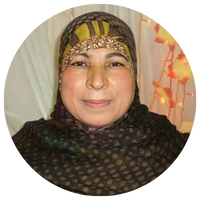
1. Personal information
a. Birth: Ms. Samia Shanan was born in 1958. She was arrested on 19 September 2013, at the age of 55, in connection with the “Kerdasa massacre” case.
b. Upbringing: She grew up in the village of Nahia in the Kerdasa area of Giza Governorate. She is the mother of three sons: Tarek, Osama and Hassan.
c. Occupation: Fruit seller.
d. In the spotlight: Ms. Samia came into the spotlight because of a video of her that spread in 2013 after the “Kerdasa massacre” events, in which she appeared to be implicated, with others, in the storming of Kerdasa Police Station. She returned to the spotlight in 2021 after the fifth episode of the TV drama series “El-Ekhteyar 2” (The Choice 2) caused wide controversy. The episode showed a woman taking part in dragging and killing officers of Kerdasa Police Station and giving the station’s deputy chief acid (“fire water”) to drink when he asked for water, in a reference to the prisoner Samia Shanan, even though the court had denied that this ever happened. This led to a wide social media campaign between those who supported and those who rejected her portrayal in a drama. The attention grew further because she is the longest-held of the women imprisoned in political cases, the only woman in the case known in the media as the “Kerdasa massacre”, and was the first woman political prisoner to be sentenced to death at the time.
2. Previous arrests: Ms. Samia was not arrested in any other case.
3. Timeline since the arrest
a. Background of the arrest:
– 19 September 2013, arrest: Ms. Samia and her son Hassan were arrested at their home in the Kerdasa area during a wide campaign launched by the Egyptian security forces after the “August 2013 events” known as the “Kerdasa massacre”, in which Kerdasa Police Station was stormed and a number of officers and police personnel and two residents were killed. She was arrested on the accusation of assaulting the station’s deputy chief during the storming.
b. Background of the case: She was added to Case No. 12749 of 2013 Kerdasa Felonies, registered as No. 4804 of 2013 North Giza Plenary, known in the media as the “Kerdasa massacre” case.
The case began in August 2013, after the dispersal of the Rabaa sit-in, when a number of people stormed Kerdasa Police Station, killing about 11 police personnel as well as two local residents who happened to be there. In September 2013, a number of men, children and one woman were arrested during a wide campaign targeting some terrorist elements in Kerdasa, along with a number of local residents and supporters of the late President Mohamed Morsi. Ms. Samia is the only woman in the case, which includes 188 defendants: 151 who were actually arrested, 35 fugitives and two who have died.
c. Charges: The referral order included several charges against Ms. Samia, defendant No. 70 in the case, including:
– Taking part in an assembly outside Kerdasa Police Station and possessing weapons and ammunition.
– Killing about 11 police personnel, including the station chief and his deputy, and two residents who happened to be there.
– Attempting to kill 30 other members of the police station force.
– Storming the police station.
– Sabotage, damaging the station building and stealing its contents, and burning a number of police cars and armored vehicles.
– Mutilating the body of the deputy chief of Kerdasa Police Station, Amer Abdel Maksoud, by making him drink acid on 14 August 2013. The Egyptian judiciary denied that this ever happened.
d. Trial and sentences:
– 21 September 2013, confession video: After her arrest, Ms. Samia was forced to record a video confessing to the charges above. However, she stated in the prosecution’s investigation that she recorded the video under threat from the security forces, and she asked to be examined by the forensic medicine authority to document the wounds and injuries she suffered from torture.
– February 2014, referral to the Criminal Court: The late Public Prosecutor Counselor Hisham Barakat referred the defendants in the “Kerdasa massacre” case to the competent criminal court on charges of committing a number of terrorist crimes, chief among them the massacre at Kerdasa Police Station in August 2013, at the same time as the dispersal of the Rabaa Al-Adawiya and Nahda sit-ins, which killed the station chief, his deputy, 9 police personnel and two residents.
– 2 December 2014, referral to the Mufti: The Criminal Court referred her papers and those of 182 others to the Grand Mufti of the Republic.
– 2 February 2015, first Criminal Court verdict: The Giza Criminal Court, presided over by Judge Mohamed Nagy Shehata, with Counselors Yasser Yassin and Abdelrahman Safwat as members, sentenced her to death along with 182 others: 149 sentences in person and 34 in absentia. The criminal case against 2 defendants, Mohamed Mostafa and Mahmoud Abdel Razek, was dropped because they had died; a juvenile defendant, Ali Mohamed Farahat, was sentenced to 10 years in prison; and 2 others were acquitted.
– March 2015, appeal against the first Criminal Court verdict: 156 defendants, including Ms. Samia Shanan, appealed the sentences against them.
– 3 February 2016, appeal accepted and retrial ordered: The Court of Cassation overturned the first verdict and ordered a retrial before another circuit, after finding that some trial procedures were invalid and that the court had violated the rights of the defense.
– 2 July 2017, second Criminal Court verdict: The Cairo Criminal Court, presided over by Judge Mohamed Sherine Fahmy, reduced the sentences of about 80 defendants, including Ms. Samia Shanan, to life imprisonment instead of death.
It also sentenced 20 other defendants to death, a juvenile to 10 years in prison, and acquitted 21 others.
In its reasoning at the time, published by the Egyptian media, the court said:
“The court calls on anyone speaking about the case to seek accuracy and truth, and not to be swept along by malicious rumors aimed at stirring public opinion and undermining the judiciary and its standing by publishing false news about imaginary events that have no basis in the case papers.”
The court added:
“The case papers contain nothing indicating that any of the defendants used any burning chemical substance (acid), whether by giving it to any of the victims or by throwing it at them.”
– 24 September 2018, second appeal: The defendants appealed a second time before the Court of Cassation, which rejected their appeals, making the sentences against them final and not open to any further appeal.
4. Detention conditions
a. Places of detention: After the arrest of Ms. Samia Shanan and her son Hassan, they were held in an unknown location. She was then transferred to Al-Qanater Women’s Prison, where she was held in pretrial detention. After being sentenced to death she was moved to the “special ward” for women sentenced to death, and after her sentence was reduced she was moved to the wards for convicted women in the same prison, where she is still serving her sentence.
b. Violations:
– Severe beating and insults during her arrest at home with her son.
– Unlawful detention inside National Security premises.
– Being subjected to several kinds of torture inside National Security premises to force her to confess to the charges against her.
Ms. Samia’s son Osama says his mother was subjected to the worst kinds of torture after her arrest, to the point that a soldier put his shoe in her mouth. She was also threatened with rape in front of her youngest son if she did not confess to mutilating the body of the deputy chief of Kerdasa Police Station.
– Degrading treatment inside Al-Qanater Prison.
– Social stigma from the claim that she poured acid on the station’s deputy chief, even though this never happened.
– Being portrayed in a TV drama (El-Ekhteyar 2) in a way that contradicts the facts, without any accountability.
– Being barred from attending the funeral of her mother, who died on 18 June 2020.
c. Living conditions in prison: Ms. Samia is the longest-held woman political prisoner in Egyptian prisons. Some prisoners at Al-Qanater Women’s Prison call her “the mother of the detainees” because of her tenderness, her concern for them and her sense of responsibility towards them. She is also known in the prison for constantly singing and for her sweet-voiced prayers before the dawn prayer.
Ms. Samia has lived through many administrations at Al-Qanater Women’s Prison, many of which treated her violently. Many former prisoners have said that Ms. Samia was constantly insulted and cursed, and that food was withheld from her many times to put pressure on her.
Things got worse after a scene in the series El-Ekhteyar 2 gave an untrue account of Ms. Samia, followed by a smear campaign against her in the Egyptian media. This led to constant abuse of her inside the prison, not only by the administration but also by other prisoners. It did not stop there: anyone who showed sympathy with the case in general was attacked. One example is the campaign against Mahienour El-Masry for her sympathy with Ms. Samia Shanan, after Ms. Mahienour El-Masry condemned the smear campaign accusing Ms. Samia of making the Kerdasa Police Station chief, Mohamed Gaber, drink acid, when the court had cleared her of that charge.